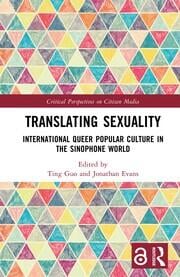

ABSTRACT

This collection critically examines the translation of international queer media and popular culture in China, offering insights into how queer media travels across international borders and interacts with mainstream media flows and local cultures. The book brings together work from queer translation studies as well as emergent research on methodologies and online subcultures to explore not only textual translation but reception and media cultures. Case studies range from television shows such as Heartstopper to The L Word and films such as Carol and Call Me by Your Name. In exploring diverse genres and forms of media, chapters collectively elucidate the ways in which popular culture can transmit ideas about sexuality and subsequently, how these ideas are negotiated, adapted, and altered in translation. This book will be of interest to students and scholars in translation studies, Chinese studies, gender and sexuality studies, and media studies.

The Open Access version of this book, available at Home | Taylor & Francis eBooks, Reference Works and Collections , has been made available under a Creative Commons Attribution (CC BY) 4.0 International license.

chapter |20 pages

Introduction

Title
Translating sexualities in the Sinophone world
Size: 0.28 MB

chapter 1|24 pages

Remix in the age of cybertextual intermediation

Title
Ergodic iterations of Carol (2015)
Size: 0.31 MB

chapter 2|18 pages

In search of lesbian utopia

Title
Sinophone queer women's rejection of lesbian masculinity and misreading of The L Word
Size: 0.10 MB

chapter 3|17 pages

Uncovering a queer translator's agency

Title
A textual and paratextual analysis
Size: 0.27 MB

chapter 4|25 pages

(Re)Framing the paratextual homographesis

Title
A case study of Call Me by Your Name in the Chinese Mainland
Size: 0.29 MB

chapter 5|20 pages

The coming out of teen homosexuals

Title
A textual analysis of the Chinese subtitles of Heartstopper
Size: 0.31 MB

chapter 6|23 pages

Digital desires and defiant narratives

Title
Real-person fiction and the reshaping of LGBTQ+ identities in Chinese fandom
Size: 0.30 MB

chapter 7|21 pages

Self-censorship, concession, and resistance

Title
The translation and adaptation of Japanese yuri animation on Bilibili and its reception among Chinese yuri fans
Size: 0.33 MB

chapter 8|17 pages

Intersectionality is what gets lost in translation

Title
From Saving Face (2004) to The Half of It (2020)
Size: 0.29 MB

chapter 9|8 pages

Interview with Jacob Huang

Title
Size: 0.23 MB