
ABSTRACT
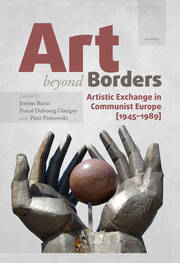
This book presents and analyzes artistic interactions both within the Soviet bloc and with the West between 1945 and 1989. During the Cold War the exchange of artistic ideas and products united Europe’s avant-garde in a most remarkable way. Despite the Iron Curtain and national and political borders there existed a constant flow of artists, artworks, artistic ideas and practices. The geographic borders of these exchanges have yet to be clearly defined. How were networks, centers, peripheries (local, national and international), scales, and distances constructed? How did (neo)avant-garde tendencies relate with officially sanctioned socialist realism? <br><br>The literature on the art of Eastern Europe provides a great deal of factual knowledge about a vast cultural space, but mostly through the prism of stereotypes and national preoccupations. By discussing artworks, studying the writings on art, observing artistic evolution and artists’ strategies, as well as the influence of political authorities, art dealers and art critics, the essays in Art beyond Borders compose a transnational history of arts in the Soviet satellite countries in the post war period.
TABLE OF CONTENTS
part I|107 pages
Moving People
chapter 3|11 pages
The British Art Critic and the Russian Sculptor: The Making of John Berger's
chapter 5|9 pages
Twinkling Networks, Invisible Ties: On the Unofficial Contacts of Byelorussian Artists in the 1980s
chapter 8|11 pages
The Murals by Spanish Exile Josep Renau in Halle-Neustadt, a Socialist Town Built for Chemical Workers in the GDR
chapter 9|12 pages
Women Artists' Trajectories and Networks within the Hungarian Underground Art Scene and Beyond
part II|127 pages
Moving Objects
chapter 12|14 pages
Picasso behind the Iron Curtain: From the History of the Postwar Reception of Pablo Picasso in East-Central Europe
chapter 17|15 pages
Nationalizing Modernism: Exhibitions of Hungarian and Czechoslovakian Avant-Gardes in Warsaw
chapter 20|9 pages
International Contact with Mail Art in the Spirit of Peaceful Coexistence: Birger Jesch's Mail Art Project (1980–81)
part III|138 pages
Gathering People
chapter 21|29 pages
(Socialist) Realism Unbound: The Effects of International Encounters on Soviet Art Practice and Discourse in the Khrushchev Thaw
chapter 22|14 pages
“Friendly Atmospheres”? The Union Internationale des Architectes between East and West in the 1950s
chapter 23|11 pages
Zagreb as the Location of the “New Tendencies” International Art Movement (1961–73)
chapter 24|12 pages
The Graphic Arts Biennials in the 1950s and 1960s: The Slim “Cut” in the Iron Curtain— The Bulgarian Case
chapter 28|12 pages
Correcting the Czech(oslovakian) Error: The Cooperation of Hungarian and Czechoslovakian Artists in the Face of the Warsaw Pact Invasion of Czechoslovakia
chapter 29|11 pages
Crossing the Border: The Foksal Gallery from Warsaw in Lausanne/Paris (1970) and Edinburgh (1972 and 1979)
chapter 30|10 pages
To Each Their Own Reality: The Art of the FRG and the GDR at the Musée d'Art Moderne de la Ville de Paris in 1981
part IV|82 pages
Defining Europe
