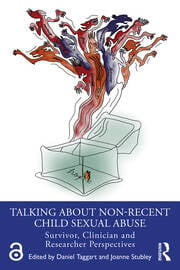

ABSTRACT
This book addresses the issue of non-recent child sex abuse and its long-term impact on adult survivors from a broadly psychodynamic perspective.
Non-recent CSA is not a subject that can or should be confined to the clinical arena. It has legal, welfare and profound social implications, with its impact broadening out from the survivor to the family to the community and into wider society. The politics of power and oppression are intertwined with the experience and may be unconsciously repeated into adult experiences, often worsened by the interplay of intersectionality and the withdrawal of public services and support for people with complex mental health problems. This book has been developed to support survivors, families, practitioners and the wider public break the social taboo around the topic of child sexual abuse. It unites a broad range of voices to encourage better community support and improve social services to support those impacted.
With an ethical commitment to the field, this book will appeal to clinicians working in mental health but will also hold interest to those in other fields such as the social sciences, as well as the interested public, and CSA survivors in particular.
TABLE OF CONTENTS
part Section I|70 pages
Scene setting
chapter 1|19 pages
Survivors speak about trust and the (un)trustworthiness of service providers
chapter 3|18 pages
“To think about what we are doing”
part Section II|62 pages
Intersectionality
chapter 6|24 pages
“I didn't think I had rights that protected me as a human being”
chapter 7|19 pages
Shooting the messenger and the curse of Cassandra
part Section III|36 pages
Words and silence
chapter 9|15 pages
Silent, silenced, and silencing
part Section IV|36 pages
Clinical perspectives
part Section V|34 pages
The professionals
chapter 13|22 pages
Communications from the edge of disclosure
chapter 14|10 pages
The importance and struggle for teams to think reflectively when working with people who have experienced childhood sexual abuse
part Section VI|49 pages
Systemic and social perspectives
