
ABSTRACT
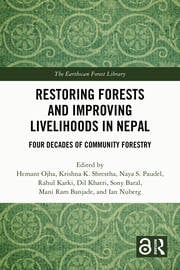
This book presents a comprehensive review of new research and practice-based insights from Nepal’s four decades of community forestry development, delving into when and how community-based management can lead to forest landscape restoration and equitable livelihoods.
With over four decades of formal program history, Nepal’s community forestry is a rare case from the Global South showcasing the trajectories and outcomes of a community-based environmental management initiative. It offers historically proven lessons of what it takes to restore degraded forests in a way that empowers local communities to make decisions. The book showcases research and experiential insights of those who became part of Nepal’s community forestry movement from the early years to the current stage. Tracing stories of change from the era of "Himalayan degradation" in the 1970s to the globally hailed success of community forestry in the 2000s, the book demonstrates how the policy, political economy, and changing community dynamics have shaped the everyday practice of community forestry and its contribution to livelihoods and forest restoration. It reveals how small-scale work in the early years evolved into a complex system of community forestry, exposing the challenges associated with social exclusion, resource management, and policy environment. As such, it makes an important contribution to the global knowledge on community-driven forest landscape restoration in the Global South where forest ecosystems are inseparable from the everyday life and livelihoods of local communities.
This book will be of great interest to students, scholars, and practitioners working on forest restoration and conservation, community development, environmental policy and planning, and sustainable development more widely.
The Open Access version of this book, available at https://www.taylorfrancis.com, has been made available under a Creative Commons Attribution-Non Commercial-No Derivatives (CC BY-NC-ND) 4.0 license.
TABLE OF CONTENTS
part |36 pages
Introduction
chapter 2|14 pages
Looking back, moving forward
part Theme 1|55 pages
Resource tenure and governance
chapter 3|17 pages
The politics of policy evolution
chapter 4|19 pages
Contested tenure
chapter 5|17 pages
Cross-scale governance
part Theme 2|74 pages
Community dynamics, local institutions, and planning
chapter 6|17 pages
Crumbling commons?
chapter 7|17 pages
Institutions at crossroads
chapter 8|18 pages
Unveiling the elite nexus
chapter 9|20 pages
Reframing community forestry
part Theme 3|72 pages
Forest ecology and management
chapter 10|18 pages
Community forestry ecologies
chapter 11|18 pages
Rethinking forest management
chapter 12|18 pages
Restoring forest ecosystems?
chapter 13|16 pages
Forest-farm interface
part Theme 4|36 pages
Climate change
chapter 14|17 pages
Restoring systems thinking
chapter 15|17 pages
The carbon promise
part Theme 5|52 pages
Livelihoods, gender, and equity
chapter 16|15 pages
Beyond natural capital
chapter 17|17 pages
Beyond tokenism
chapter 18|18 pages
The business potential of community forestry
part |18 pages
Conclusion
