
ABSTRACT
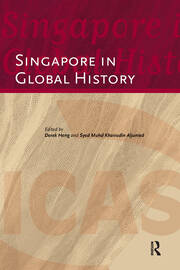
In recent years scholars of Singapore’s history have called for the historiography of the island to be reconfigured. Reviewing a wide range of studies on Singapore’s history and exploring ways to ask new questions about the island’s past, historian Albert Lau has proposed that historical narratives about the country should be contextualised more broadly. One alternative way of narrating Singapore’s history, he suggests, could be “within the framework of regional and world history” (Lau 2004: 50-51). Like Lau, Derek Heng, Kwa Chong Guan, and Tan Tai Yong have made a similar appeal for the Singaporean historical narrative to be rethought in a wider context. Eventually collaborating to write such a story, they focus in their jointly-authored book on the larger regional and international economic and strategic environment that has affected Singapore’s development since the fourteenth century. International actors, global trade flows, and regional players have shaped the course of Singapore’s historically contingent and non-preordained journey towards becoming a global city-state (Heng, Kwa & Tan 2009). Finally, another collection of articles edited by Syed Muhd Khairudin Aljunied and Derek Heng have likewise reframed the historiography of Singapore, using comparative and transnational perspectives to rewrite the island’s history in a broader and more cosmopolitan context. The stimulating and thought-provoking essays in that volume ask new questions and generate new insights into how trans-regional linkages and concerns about global economic competition ultimately shaped histories and identities in Singapore (Heng & Aljunied 2009). What ties these recent historiographical trends together is a profound recognition that insular narratives which privilege the local are no longer intellectually satisfying. Given the fact that Singapore’s economic, demographic, and intellectual development has historically not been immune to forces unleashed by changing societies elsewhere in the world, these recent appeals for a reorientation of Singaporean history towards broader contexts and themes could not be timelier. A yawning gap needs to be bridged between lived experience and historical scholarship. As the island’s longstanding cosmopolitanism has rendered its society and economy open to external influences and trends, it is important to examine how Singapore’s connections to these international and transnational movements and developments have shaped its history (Harper 1997). The notion of an island entity — geographically situated at one of the most important and strategic economic crossroads in the world — that is impervious to external influences and developments is conceptually limited and historically unrealistic. If historians studying the island’s past adopt an analytical focus that is narrowly national and insular, they will miss much that has had an impact on Singapore. Conversely, to comprehend the multiple dimensions of Singaporean life, it is necessary to enmesh Singaporean history with other histories. Local history should be investigated in the context and light of other historical events taking place across the globe.
