
ABSTRACT
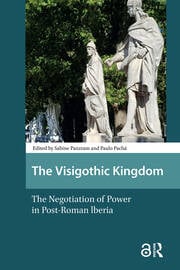
Visigothic kings remain present in Madrid to this day. Athaulf, Euric, Liuvigild, Swinthila, and Wamba face each other on the Plaza de Oriente; Gundemar and Chintila can be spotted in the Retiro Park by the ‘Paseo de las Estatuas’; Alaric, Reccared II, Erwig, and Theodoric meanwhile grace the balustrade of the royal palace’s eastern facade. These carefully crafted, life-size statues of white rock (Piedra de Colmenar), obviously part of some programme, are haphazardly spread across the city, which leads us to the mid-eighteenth century. After Real Alcázar burned to its foundations on New Year’s Eve, 1734, 1 Philipp V charged the Benedictine Martín Sarmiento with developing a new palace design. He saw the destruction of the Arabic residence, previously redesigned by the Trastámara and renovated by the Habsburgs, as an opportunity to fulfil his desire for a new and imposing form of self-display. The Bourbon faced the challenge of combining his French dynasty with the older Spanish one in order to demonstrate legitimacy. By suggesting his so-called Sistema de adornos del Palacio Real (1743), Sarmiento offered a form of display in which sculptures, frescoes, and carpets would complement each other in order to display the Catholic and secular virtues of the Spanish monarchy since antiquity – virtues such as security, strength, continuity, and piety. 2 The sculptures were to represent the kings – in chronological order – and serve to crown the palace. 3 They were to be a symbol, visible to all, of sovereignty’s continuity, and to transform the palace into a place of remembrance from which Spain could be envisioned (pensar España). 4 The Benedictine described in detail what the statues were to resemble, their clothing as well as such things as their types of crowns and weaponry. The faces were not be idealized, but true to nature. This enthusiasm for documentation and didactism can be seen in the figures of martyrs, saints, and city patrons, such as San Lorenzo, San Juan de la Cruz, San Isidro, Santa Leocadia, and Santa Teresa, as well as poets such as Martial, Quintilian, and Lucan, and philosophers such as Averroes and Maimonides or ‘military types’ such as Viriathus, the Cid, and Cortés. 5 Sarmiento had stones fetched from every quarry in Spain for the construction, so that the representation of the Iberian Peninsula’s thirty-two provinces could be realized through a presence from across the kingdom. The elaborate iconographic programme reflects Sarmiento’s understanding of his nation’s continuity, which was contingent on its territory, geography, and ultimately its history. The didactic impetus is obvious: the Benedictine was convinced of architecture’s ability to unleash positive effects in the beholder and educate him through the need for guidance and moral emulation. 6 When Charles III reached Madrid, in December 1759, he found himself facing a huge construction site. He gave priority to completing the residence, which had been delayed for years, and was able to move in at the end of 1764. Iconographically, Charles III distanced himself significantly from his predecessors’ guidelines. First, he had the statues of all the Spanish kings who had been erected on the facades as part of Sarmiento’s programme removed, an order he gave on February 1760, even before his ceremonial entrance to Madrid. 7 They were then distributed across the city’s gardens – Plaza de Oriente, Sabatini, Retiro, Glorieta de las Pirámides – with some sent to various cities: Toledo received a few, Burgos, Ronda, Vitoria, Logroño, and San Fernando de Henares others, while Aranjuez, El Ferrol, and Pamplona received a few. Charles was not attempting to make the nation an ideological centre of his sovereignty by didactically instrumentalizing the royal palace. Rather, his rule sought to raise a universal claim by means of eulogies and self-dramatization to harken back to antiquity. The discovery of Herculaneum and Pompeii in the 1740s was propitious, as it served to validate his buon regno. 8 The prologue of the luxurious volume Antichità di Ercolana – which published the paintings, statues, and bronzes – was gifted to members of the European aristocracy, 9 and celebrated him as Hercules. Charles also secured the services of the notable Anton Raphael Mengs to decorate the royal palace with ceiling frescoes and historic images. 10 This Dresden court painter’s iconography was rooted in an inventory of images related to Trajan. Meanwhile, Charles’s generous renovation and beautification, even re-design, of entire neighbourhoods in the capital, 11 induced Ramón Pignatelli y Moncayo to compare his achievements with those of the first Roman empire – perhaps surpassing Augustus! 12 Finally, Charles was inspired by the Roman street network when developing his Spanish example. In 1787 he organized the colonization of Sierra Morena, in celebration of which a medal was minted showing him as Romulus, the city founder. 13 In contrast to Sarmiento, Charles was not concerned with presenting the past as an entirety, as a closed system in order to display a national identity. By referring to antiquity, he modeled an entire epoch as the starting point of socio-political transformations at a time of political conflict and social change, presenting the past as an open frame of reference. 14
