

ABSTRACT
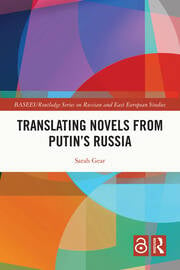
This chapter examines how publishers, rather than translators, play a primary role in politicising contemporary Russian fiction for Anglophone audiences via paratexts. Building on definitions of paratexts by Gérard Genette and Kathryn Batchelor the chapter analyses how book covers, titles, blurbs, introductions, and afterwords frame Russian novels as political artefacts. Drawing on case studies of Vladimir Sorokin's Day of the Oprichnik, Ludmila Ulitskaya's The Big Green Tent, and Mikhail Elizarov's The Librarian, it demonstrates how Anglophone publishers use book covers, titles and blurbs to position Russian writers as dissident. The chapter also considers Ulitskaya's Just the Plague and Yuri Felsen's Deceit, to show how paratextual framing connects Russian literature to contemporary political and global events. It argues that these editorial and marketing practices shape reception more powerfully than translation itself, functioning as mechanisms of cultural mediation and soft power.
