
ABSTRACT
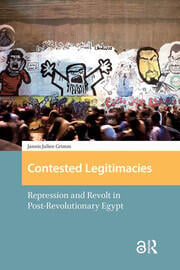
The Arab Spring left a deep imprint on Middle Eastern and North African societies, but also on social movement scholarship. In particular, three lines of inquiry provide vantage points for investigating protest in the region today: critical approaches that avoid the structuralist bias of early analyses of the Arab Spring and, instead, focus on the imaginative terrain of social protest; constructivist approaches that retrace how political subjectivation processes enabled innovative revolutionary alliances; and relational approaches that investigate the interactions between different players during the 2011 uprisings. This book is situated at the intersection of these strands of literature. It is an attempt to map contentious politics in post-revolutionary Egypt and show how different social arenas, street politics, and the politics of signification, interrelated, and informed the country’s transition.
